Check Washing Scam: When Your Own Check Is Altered
Check washing is not a fake check. It is a real check that you really signed, with the payee and the amount chemically removed and rewritten. That distinction matters because the bank's first assumption is that you authorised the payment. Your recovery depends on how fast you report the alteration and whether you can show the original terms, which is why the stub, the invoice and the postmark are worth more than the cancelled check itself.
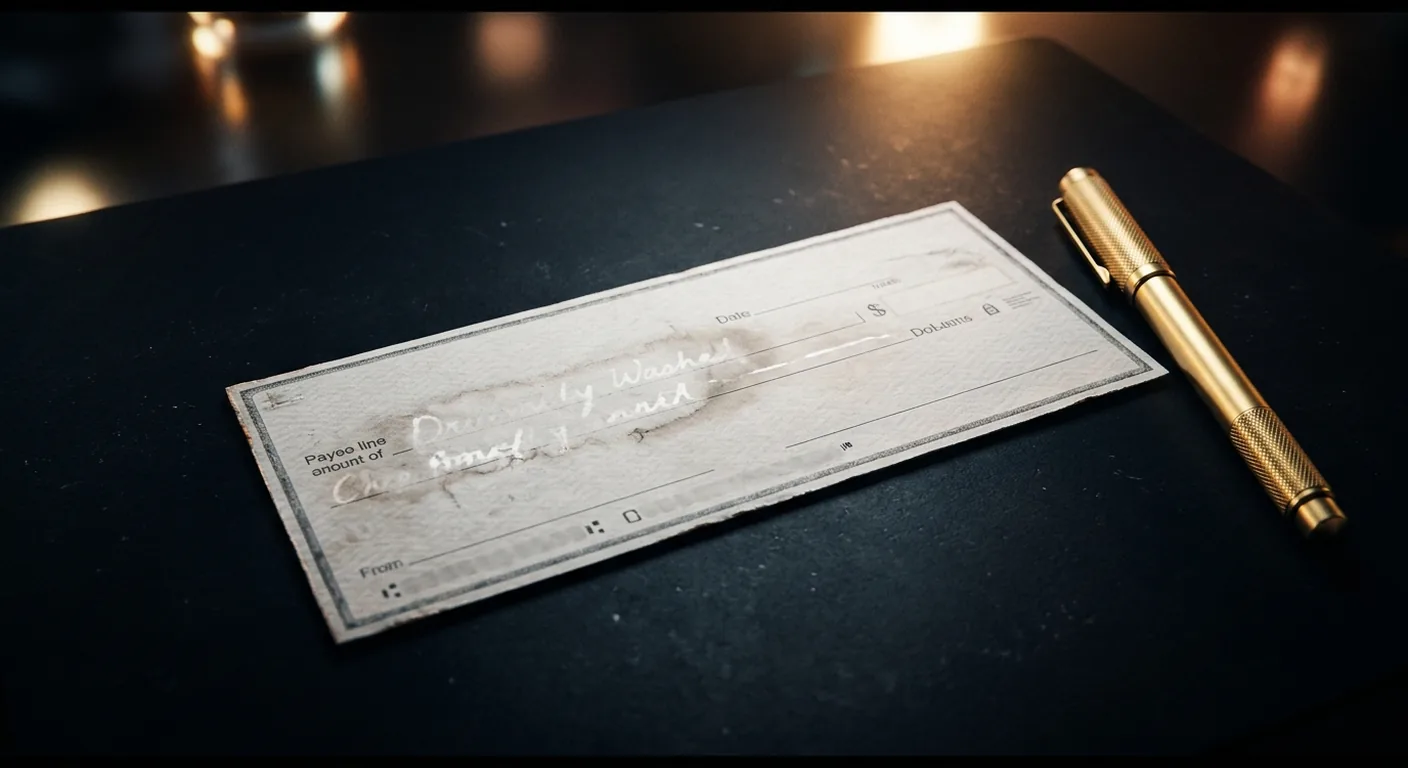
Check Washing Scam. A Real Signature on a Rewritten Check
The Short Version: Check Washing Scam
- Check washing uses common solvents to strip the ink from a check you wrote, leaving your signature intact.
- The thief rewrites the payee and the amount, often for a much larger sum, and deposits it remotely.
- Your bank's liability depends on how quickly you report the alteration after the statement arrives.
- Under UCC Article 4, you generally have one year to report a forged signature and 30 days for repeated alterations by the same party.
- The strongest evidence is not the check. It is the invoice, the stub, the postmark and your own records of what you intended to pay.
The short answer: your signature is real, the rest is not
Check washing is the alteration of a genuine check. The fraudster steals the envelope, treats the check with a solvent that dissolves the ink of a ballpoint pen, and rewrites the payee name and the amount. Your signature stays exactly where you put it, which is why the bank's automated review passes and why the first call you get is often a collections call rather than a fraud alert.
| What was changed | What the bank sees | What you must prove |
|---|---|---|
| Payee name | A check payable to someone you have never paid | Your payment records for that period |
| Amount in figures | A larger number than you wrote | The invoice or stub showing the intended amount |
| Amount in words | Often left inconsistent with the figures | A copy of the check image, which the bank must provide |
| Signature | Unchanged, and genuinely yours | Nothing. This is the part that is not in dispute |
That last row is the whole problem. Because the signature is authentic, the dispute is not "this is not my check". It is "this check was altered after I signed it". Those are different claims with different evidence requirements, and the second one is decided on documentation rather than on a fraud declaration.
How the alteration actually works
The technique is old and it is not sophisticated. Most ballpoint and gel inks are vulnerable to a small set of household and industrial solvents, and the process takes minutes rather than hours. Understanding the mechanics is useful because it tells you which checks are at risk and which are not.
- Mail interception is the entry point. Checks are taken from residential mailboxes, from the blue collection boxes on the street, and from mail rooms in apartment buildings. The theft is usually of a batch, not a single envelope.
- The ink is dissolved, not erased. Solvent is applied to the payee line and the amount boxes. The paper fibres are slightly damaged, which is why a washed check often looks faintly stained or has a visible halo around the rewritten text.
- The check is rewritten and deposited remotely. Mobile deposit means the fraudster never has to present the paper at a branch, and the image quality is often too low for a teller to notice the alteration.
- The original is destroyed. By the time you see the image on your statement, the paper is gone, which is why the bank's image is the only forensic record you will get.
Gel pens are more vulnerable than ballpoint, and both are more vulnerable than a pigment-based permanent ink. That is a real but partial defence: the durable fix is not a better pen, it is removing the paper from the mail stream entirely.

The deadlines that decide who pays
Check law is unusually specific about time, and the deadlines run from the statement, not from the theft. This is the section that determines whether the loss lands on you or on the bank.
| Rule | What it covers | Deadline | Consequence of missing it |
|---|---|---|---|
| UCC 4-406(c) | Duty to review statements and report unauthorised signatures or alterations | Promptly, and within one year of the statement | You are precluded from asserting the alteration against the bank |
| UCC 4-406(d) | Repeated alterations by the same wrongdoer | 30 days after the first statement showing the first alteration | You bear the loss for the later items |
| Bank deposit agreement | Contractual reporting window, often shorter than the statute | Commonly 30 to 60 days | The bank may refuse the claim on contractual grounds |
| Regulation E | Only applies if the item was electronic, not a paper check | 2 business days for lost access, 60 days for statement errors | Liability tiers apply |
The practical reading is blunt. Review every statement within days of it being issued, and report anything you do not recognise in writing rather than by phone. A written notice with a date creates a record of when you reported it. A phone call creates a note that may or may not exist when the claim is reviewed six weeks later.
What to do in the first 48 hours
Work in this order. The first two steps are time-critical and the rest build the file.
- Call the bank and ask for an alteration claim, not a fraud claim. The wording matters. "This check was altered after I signed it" is a different process from "I did not authorise this payment", and using the wrong one sends the file to the wrong queue.
- Place a stop payment on any check still outstanding to the same payee, and ask the bank to flag the account for unusual item activity.
- Collect the original terms. The invoice, the order confirmation, the stub in your checkbook, and any email where you agreed the amount. This is the evidence that proves what the check was supposed to say.
- Report the mail theft. File with the USPS Postal Inspection Service if the check travelled by mail, and with local police. The postal report number is often what makes a bank treat the claim as a crime rather than a dispute.
- Notify the intended payee. They are waiting for a payment that will never arrive, and a second check sent by the same route may be stolen too.
If the altered check was deposited into an account at another bank, your bank will contact that institution. You can speed this up by giving them the depository bank name from the endorsement on the back of the image. That single detail can move a claim from a general queue into a specific interbank request.
How to stop the next one
Check washing is a mail problem more than a banking problem, so the fixes are mostly about the mail.
| Change | What it prevents | Effort |
|---|---|---|
| Pay electronically where the payee accepts it | Removes the paper from the mail stream entirely | One-time setup per payee |
| Use the USPS collection box inside the building, not the street | Batch theft from outdoor boxes | None |
| Drop mail close to the posted collection time | Overnight dwell time in the box | None |
| Use a pigment-based permanent ink pen | Solvent-based ink removal | Trivial |
| Reconcile statements within a week | Missing the 30-day repeated-alteration window | 15 minutes a month |
| Sign up for account alerts on every debit | Delayed discovery of an altered item | 5 minutes |
The alerts row is the highest-value change for most people. An altered check that clears produces a debit notification the same day. That notification is what starts the clock in your favour rather than against you.
What to say when you call the bank
The wording of the first call shapes which process your claim enters, and the wrong process can cost you weeks. These are the sentences that work, and the ones that send your file to the wrong queue.
| Say this | Not this | Why it matters |
|---|---|---|
| "This check was altered after I signed it." | "I did not write this check." | The signature is yours, so the second claim is easy to disprove and delays the file |
| "The payee and amount were changed." | "Someone stole my money." | Names the specific alteration the bank must investigate |
| "I am reporting this within the statement period." | "I only noticed now." | Puts your reporting date on the record against the UCC deadline |
| "Please send me the front and back images." | "Can you look into it?" | Creates a written request and gets you the endorsement detail |
Ask for the claim reference in writing, by secure message or email, before the call ends. A reference number is what lets the next person you speak to find the file, and without it every follow-up call starts from zero.
If the first representative tells you nothing can be done, ask to speak to the claims or fraud department rather than accepting the answer. Front-line staff handle balance enquiries; alteration claims are handled by a separate team with different authority, and the transfer between them is not automatic.
Questions people ask about check washing scam
What is the difference between check washing and a fake check scam?
A fake check is entirely fabricated and you are the one who deposits it, usually after being told to send part of the money onward. Check washing is the alteration of a genuine check you wrote and signed: the payee and amount are chemically removed and rewritten. In washing, the victim is the person who wrote the check, not the person who deposited it.
How long do I have to report an altered check to my bank?
Under UCC Article 4-406 you generally have one year from the statement to report an unauthorised signature or alteration, and 30 days to report a repeat alteration by the same wrongdoer. Your bank's deposit agreement is often stricter, commonly 30 to 60 days. Report in writing as soon as you notice.
Can the bank refuse to refund a washed check because I signed it?
The bank can argue that you failed your duty to review statements promptly, which is the defence UCC 4-406 gives them. That is why the reporting date matters so much. If you reported promptly and can show the original terms of the payment, the alteration claim is usually accepted.
How do I prove what the check was supposed to say?
Use the invoice, the order confirmation, the checkbook stub and any email where the amount was agreed. The bank also must give you a legible image of the front and back of the paid item. Together these show the intended payee and amount against what was actually paid.
Does mobile deposit make check washing worse?
It makes detection harder. A remote deposit produces a low-quality image, and the paper check is often destroyed afterwards, so a teller never inspects it. That is one reason alteration claims are decided on documentation rather than on physical examination of the item.
Should I stop writing checks altogether?
For recurring bills, yes, electronic payment is safer and faster. For the occasional payment to a small business or an individual, a check is still reasonable if you mail it from a secure box, use a permanent-ink pen, and reconcile your statement within a week.
Find the invoice before you call the bank
The alteration claim is won on documentation. The invoice and the stub prove what the check was meant to say, and that is the whole case.
Primary sources and further reading
- USPS Postal Inspection Service — Report mail theft — uspis.gov
- FTC — Consumer Sentinel Network data — ftc.gov
- FBI IC3 — File a Complaint — ic3.gov
- CFPB — Submit a complaint about a bank — consumerfinance.gov
- Federal Reserve — Regulation CC (funds availability) — federalreserve.gov
Related guides
Information only. We never promise recovery.