USDC Sent to the Wrong Network? How to Get It Back
USDC is the one wrong-network case with a genuinely good ending in most instances, and the reason is structural rather than lucky: Circle issues native USDC on more than twenty chains at the same address on each, so a transfer sent to the wrong chain is generally sitting at an address you already control. The recovery is not a support ticket or a fee. It is finding the right contract address on the right chain, and most people never get that far because they search for a recovery service instead.

USDC on the Wrong Network. Usually Recoverable, If You Stop
USDC Sent to the Wrong Network: The Short Version
- Native USDC exists on 20+ chains at the same contract address only within a chain — the token contract differs per chain, the wallet address does not.
- If you sent USDC to your own address on the wrong chain, it is not lost. Switch networks and add Circle's contract for that chain.
- If you sent it to an exchange deposit address on an unsupported chain, only the exchange can credit it. Open one ticket and send nothing else.
- Circle cannot reverse a confirmed transfer and does not run a recovery desk. Anyone claiming otherwise is running a second scam.
- The most common real failure is not the wrong network — it is adding a fake USDC contract from a search result and seeing a spoofed balance.
The short answer: which of three cases you are in
People use one phrase — "USDC sent to the wrong network" — for three situations that have almost nothing in common. Work out which one you are in before you touch anything, because the right action in one case is actively harmful in another.
| Case | What actually happened | Who can fix it | Outcome |
|---|---|---|---|
| You sent to yourself, wrong chain | Destination address is yours. It exists on the receiving chain because the same private key derives it. | You | Recoverable — minutes to hours |
| You sent to an exchange, wrong chain | Destination is the exchange's deposit address; their system did not see the chain you used. | The exchange | Often recoverable — ticket, sometimes a fee |
| You sent to someone else, wrong chain | Destination is a stranger's address on a chain they may not use. | Only that person | Usually not — no technical route |
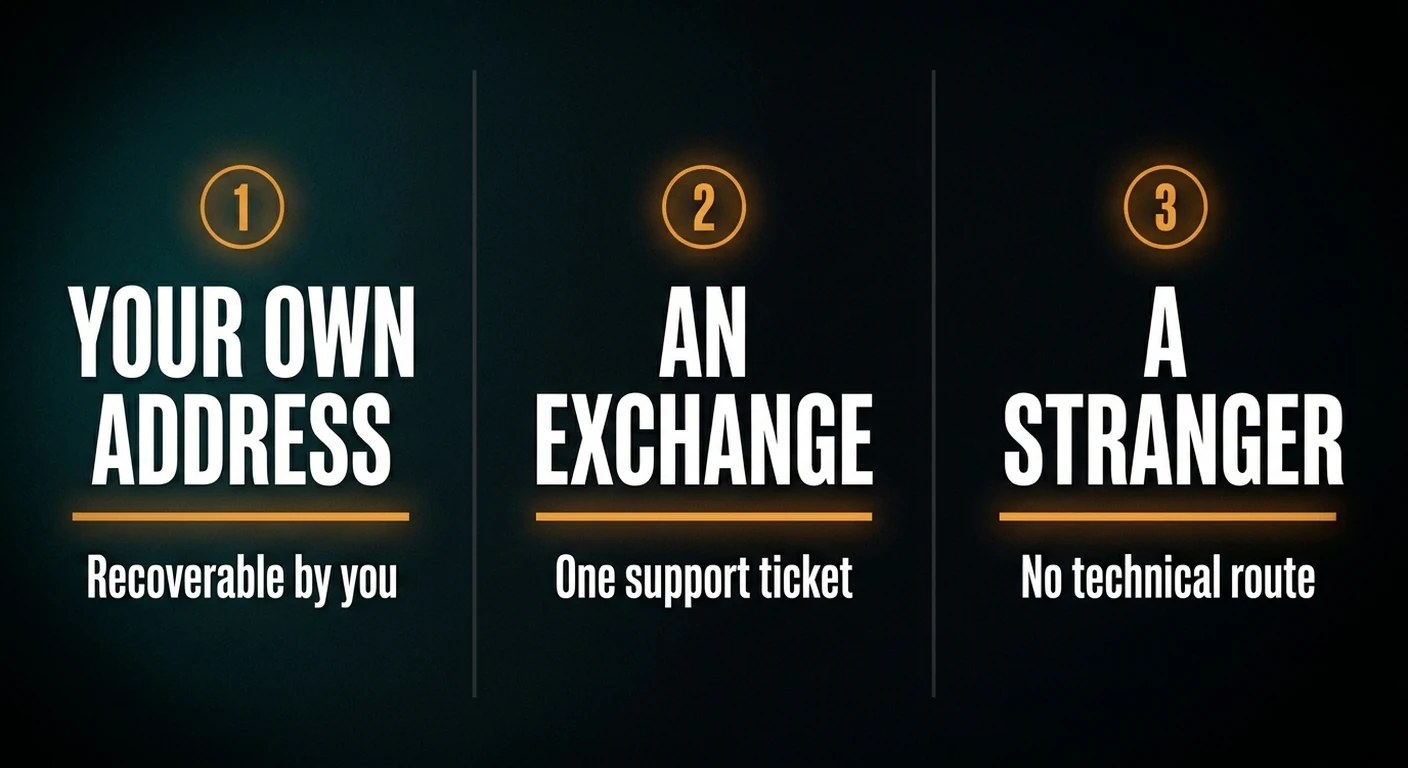
The first case is the one this page is mostly about, because it is both the most common and the one you can finish yourself. The distinction that decides everything is this: on EVM chains your address is derived from your private key, so the same key produces the same address on every EVM chain. The funds are not in limbo. They are at an address you can already sign for — your wallet is just not displaying that chain.
Step 1: confirm which chain the transfer actually used
Do not trust your memory of which network was selected. Wallets switch defaults, and the selector is easy to miss. The transaction hash is the only reliable record.
Find the hash and resolve it on an explorer
Open the transaction in your wallet's activity list and copy the hash. Paste it into the block explorer for the chain you think you used. If it returns "transaction not found", that is not an error — it is the answer: you used a different chain. Repeat on the other candidates.
| Explorer | Chain | Typical USDC variant |
|---|---|---|
| etherscan.io | Ethereum | Native USDC (Circle) |
| basescan.org | Base | Native USDC (Circle) |
| arbiscan.io | Arbitrum One | Native USDC (Circle) |
| polygonscan.com | Polygon PoS | Native USDC (Circle) |
| optimistic.etherscan.io | OP Mainnet | Native USDC (Circle) |
| snowtrace.io | Avalanche C-Chain | Native USDC (Circle) |
| solscan.io | Solana | Native USDC — non-EVM, different address |
| tronscan.org | Tron | USDC on Tron — non-EVM, different address |
Diagnosing the failure correctly is the whole game, and wrong address versus wrong network covers both cases side by side.
Step 2: if it is your own address, add the chain and the correct contract
This is the fix most people can complete themselves, and it takes about ten minutes. The principle: your address already exists on the receiving chain; what is missing is the chain in your wallet and the token contract on that chain.
The four moves
| # | Move | Why it is necessary |
|---|---|---|
| 1 | Add the receiving network to a wallet that holds the same private key or seed | The balance cannot display on a chain the wallet is not configured for |
| 2 | Add Circle's official USDC contract for that chain | USDC is a token, not the chain's native asset — wallets do not auto-detect it |
| 3 | Confirm the balance matches the amount you sent | Confirms you found the real contract, not a spoofed one |
| 4 | Bridge or transfer to the chain you actually wanted | Only after step 3 passes — this is a second transaction with its own gas and risk |
Where the contract address comes from: Circle publishes the canonical USDC contract address for each supported chain in its developer documentation. Use that page. Do not use an address from a wallet's "add custom token" autocomplete, a block explorer comment, or a screenshot.
What breaks at step 3
If the balance shows a huge number that is clearly wrong, or the token symbol is USDC but the decimals do not render, you have added a fake contract. Remove the token from the wallet's display list — do not interact with it, do not approve it, and do not "swap" it. A spoofed token exists to get you to sign an approval.
Step 3: if the destination is an exchange, only the exchange can help
If your USDC landed on an exchange deposit address on a chain that exchange does not credit, the funds are at an address whose private key the exchange controls. Nothing you can do locally will move them. This is not a dead end, but it is a queue you cannot jump.
What one good ticket contains
- The transaction hash — not a screenshot of it, the hash string itself.
- The chain you sent on, named exactly as the explorer names it.
- The chain the deposit address was issued for, and the token (USDC, and whether it was native or a bridged variant).
- The exact amount and the destination address, copied from the explorer rather than typed.
- What you have already tried, so the first reply is not a request to redo it.
Two rules that decide the outcome
Send nothing else to that address. A second deposit does not "unlock" the first, and on some exchanges additional misdirected funds complicate the account's reconciliation rather than helping it.
Never give a seed phrase, private key, or a remote-access session to anyone who contacts you claiming to be from the exchange. Exchanges do not ask for these in a support ticket, and a wrong-network deposit is a known pretext that scammers search for.
Recovery fees for this service exist and are legitimate when charged by the exchange itself through its own published process. A fee demanded by a third party who found you in a forum is not the same thing.
The USDC cases that really are gone
Being straight about this is more useful than optimism, because the wrong kind of hope is what the second-scam industry sells.
- Sent to a burn address. No private key exists. Nothing can ever move it.
- Sent to a contract with no withdrawal path. Some contracts accept inbound tokens and have no function to send them out. The project team may be able to help if the contract is upgradeable — ask, but expect nothing.
- Sent from an EVM chain to a non-EVM address by mistake. The address formats are incompatible; the funds are not sitting at "your" address on the other chain because the key derivation is different.
- Sent to a stranger who will not return it. The blockchain executed your instruction correctly. There is no technical undo.
In all four cases a trace of the stolen crypto can still establish where the funds went, and that record has real value in a police report or an exchange investigation. It does not return them. Be careful with any service that blurs that distinction \u2014 the wrong-address case has its own recovery path and its own limits.
The second scam that follows this exact search
Search for "recover USDC wrong network" and you enter a market built specifically for you. The people running it read the same search results. Four patterns account for most of it.
| Pattern | What they say | What it actually is |
|---|---|---|
| The "Circle recovery desk" | "We can reverse the hash through Circle." | Circle cannot reverse a confirmed transfer. No such desk exists. |
| The upfront unlock fee | "Pay the network fee and we release the funds." | There is nothing to release. The fee is the product. |
| The remote session | "Let me connect and check your wallet." | Screen share plus your seed phrase equals an emptied wallet. |
| The Telegram DM | "I saw your post, I had the same problem, here is the agent who fixed it." | A two-account script. The second account is the same person. |
The tell is not the price and not the professionalism. It is the direction of money: a legitimate process never requires you to send funds to receive funds. Exchanges charge retrieval fees by debiting the recovered amount, not by asking for a transfer first.
Preventing the next one
- Send a test amount first on any new chain-and-recipient combination, and confirm arrival before the rest.
- Read the network name in the wallet before confirming — the selector defaults to whatever you last used, which is how most of these happen.
- Save the contract address you verified once, so future sends do not require a fresh search that could return a fake.
- Prefer CCTP-native USDC when moving between supported chains — it is the transfer path designed to avoid this class of mistake, rather than a bridged variant.
- Keep one wallet per purpose (long-term, trading, test) so a mistake is contained by design.
Questions people ask about USDC on the wrong network
Can I recover USDC sent to the wrong network?
Usually yes, if the destination address belongs to you. On EVM-compatible chains the same private key derives the same address, so the funds are at an address you control on the receiving chain. Add that chain to your wallet and add Circle's official USDC contract for it. If the destination belongs to an exchange, only the exchange can credit or return the funds. If it belongs to a stranger or a burn address, there is no technical route.
Does Circle or Coinbase reverse a USDC transfer?
No. Circle states that it cannot recover funds sent to the wrong address or network, and a confirmed transfer cannot be reversed by anyone. Circle does not operate a recovery desk. Any service claiming to act "through Circle" to reverse a hash is misrepresenting how the network works.
How do I find the real USDC contract address for a chain?
Use Circle's own developer documentation, which lists the canonical USDC contract address for each supported chain. Verify it in the chain's block explorer before adding it: real USDC has millions of holders and a long history on that chain. A contract created recently with very few holders is a spoofed token, and interacting with it can expose you to an approval drain.
I sent USDC to an exchange on the wrong network. What now?
Open one support ticket with the transaction hash, the chain you sent on, the chain the deposit address was issued for, the exact amount and the destination address. Send nothing else to that address in the meantime, because a second deposit does not unlock the first. Recovery fees for this are legitimate when the exchange charges them through its own published process. Never share a seed phrase or allow remote access.
Is USDC sent to the wrong network lost forever?
Not usually, but it depends entirely on who controls the destination. Your own address on another EVM chain is recoverable by you. An exchange address is recoverable through the exchange's process. A burn address, a contract with no withdrawal function, a stranger's address, or an incompatible non-EVM address is effectively lost, and no fee or service changes that.
What is the difference between wrong network and wrong address?
Wrong network means the address is right but the chain is not; on EVM chains this is usually recoverable because the same key controls the address on both chains. Wrong address means the destination is someone else's; only their voluntary return can help. Before doing anything else, confirm which one happened from the transaction hash rather than from memory.
Confirm the chain before you conclude anything
The transaction hash tells you which of the three cases you are in, and that is what decides whether recovery is possible at all.
Primary sources and further reading
- Circle — Sent USDC to the wrong address or network — help.circle.com
- Circle Developer Docs — USDC contract addresses by chain — developers.circle.com
- MetaMask — I sent crypto to the wrong place — support.metamask.io
- FBI IC3 — File a Complaint — ic3.gov
- TrueMoneyTalk — Sent Crypto to the Wrong Address? — truemoneytalk.com
Related guides
Information only. We never promise recovery.