Crypto Investment Scam Playbook: All Seven Stages, Decoded
A crypto investment scam is not one trick. It is a seven-stage process, and each stage exists to make the next one feel reasonable. Here is every stage, the moment it becomes visible, and the exit point that still works.
Crypto Investment Scam Playbook: The Seven Stages
- A crypto investment scam runs in seven stages, and the first three involve no money at all.
- Each stage exists to make the next one feel reasonable, which is why the request for money arrives only after weeks of preparation.
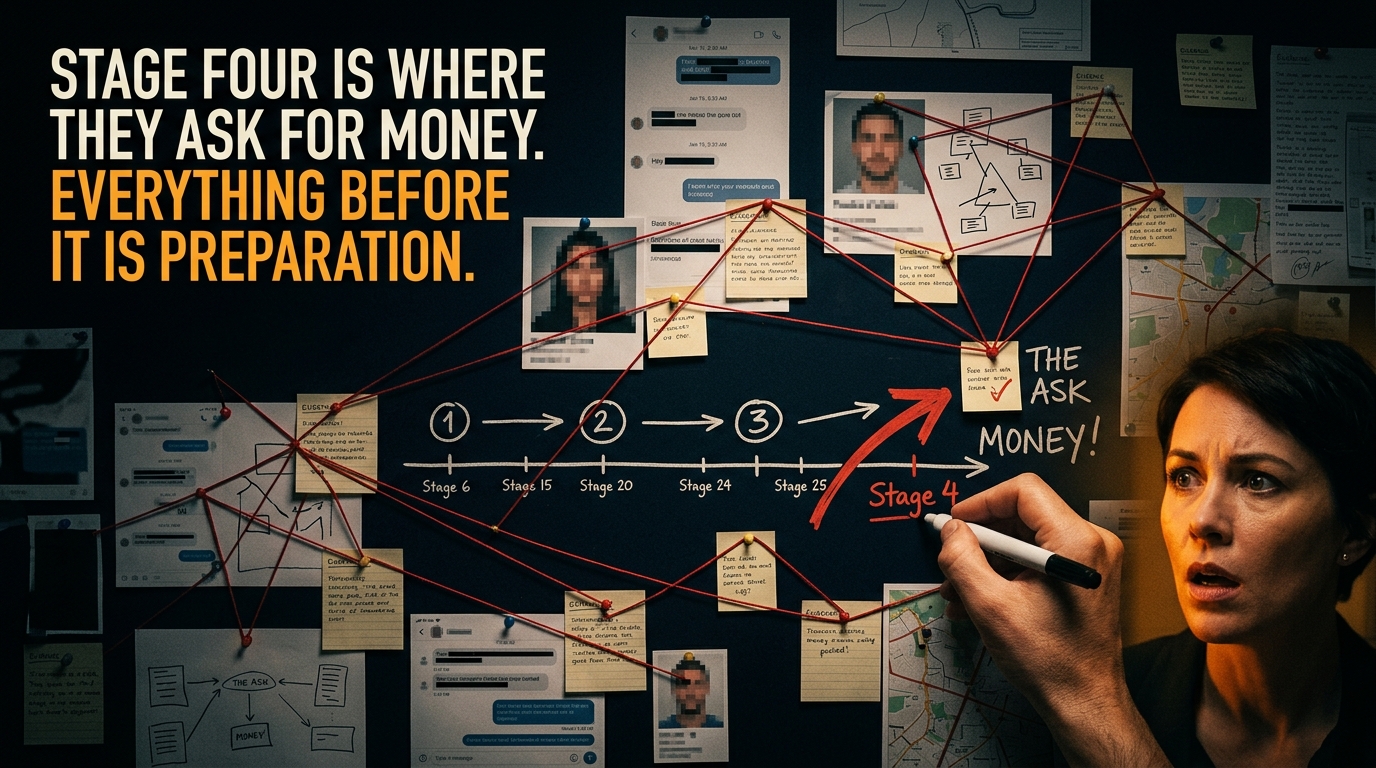
- The exit point that still works is stage four, the first deposit. After that, the cost of leaving rises with every stage.
- The stages are consistent enough to be a checklist, and recognising the stage you are in tells you what comes next.
- The second scam arrives after the loss, and it uses the same seven stages with a different opening.
A crypto investment scam is not a single trick. It is a process with seven stages, and the reason it works is that each stage makes the next one feel reasonable. By the time money is requested, the target has spent weeks building a relationship, seeing evidence, and telling people about an opportunity.
This tutorial walks through all seven stages. For each one it shows what the stage is for, what it looks like from inside, and where the exit points are. The most useful thing to know is which stage you are in, because that tells you what is coming next.
Why the scam is staged at all
A fraud could simply ask for money in the first message. It does not, because that approach fails. What works is a sequence that builds a relationship, demonstrates credibility, and creates a small commitment before the large one.
The staging is not improvisation. It is a script refined across thousands of targets, and the stages are consistent enough that recognising one tells you what the next will be.
| Stage | What happens | What it is for |
|---|---|---|
| 1. Contact | An approach through a message, ad or group | Establish a reason to keep talking |
| 2. Rapport | Weeks of ordinary conversation | Build trust before any request |
| 3. Introduction | The opportunity is mentioned casually | Make the idea feel like your own discovery |
| 4. First deposit | A small amount, often withdrawn successfully | Convert interest into commitment |
| 5. Escalation | Larger deposits, encouraged by visible profit | Maximise the amount at risk |
| 6. Blockage | Withdrawal requires a fee, tax or verification | Extract more from a committed target |
| 7. Disappearance | The platform, the contact and the group vanish | End the operation and move to the next target |
The first three stages involve no money at all. That is the point: by the time money is requested, the target has invested weeks of attention and does not want to have been wrong.
Stages one and two: contact and rapport
The approach is designed to look accidental. A wrong number, a message meant for someone else, a comment on a post, an invitation to a group. The framing varies; the function does not, which is to open a conversation that has a reason to continue.
Rapport is where the time is spent. Weeks of ordinary conversation, often with photographs, voice notes and small personal details. The operator is building the one thing that makes the later request work: a relationship in which asking for money would feel natural.
- The approach looks accidental or low-stakes.
- Conversation continues for weeks before any opportunity is mentioned.
- Personal details, photographs and voice notes are shared freely.
- The operator mirrors your interests, schedule and concerns.
- Any attempt to meet in person or video call is deflected.
- The relationship feels closer than its actual duration justifies.
A relationship that feels unusually close after a short time is the product, not a side effect. The closeness is manufactured to make the later request feel like a favour rather than a transaction.
Stage three: the casual introduction
The opportunity is never pitched. It is mentioned. A screenshot of a profit, a passing comment about a platform, a question about whether you have ever tried something similar. The goal is for the target to ask for more information.
This is the stage where the target's own curiosity does the work. Having asked, they are now invested in the answer, and the operator can present the platform as a favour being shared rather than a product being sold.
| Framing | Why it works | The tell |
|---|---|---|
| A screenshot of profit | Evidence without a claim | The screenshot is the only evidence offered |
| A relative who works in the industry | Borrows authority | The relative is never available to speak |
| A platform that is invite-only | Creates exclusivity | The invite is available to anyone who asks |
| A short window of opportunity | Creates urgency | The window never actually closes |
| A question about your experience | Makes you ask for details | You initiated the next step |
The moment you ask for more information is the moment the pitch begins. That is not a reason to panic; it is a reason to slow down and check the platform independently.
Stage four: the first deposit
The first deposit is small, and it is often withdrawn successfully. That success is the most persuasive part of the entire operation, and it is manufactured deliberately, usually funded by another victim's deposit.
This is the last exit point that is genuinely cheap. Everything after it costs more, because the target now has evidence that the platform works and a reason to defend the decision they have already made.
- 01The first deposit is small, often a few hundred dollars.
- 02The platform shows a profit within days.
- 03A withdrawal is requested and processed quickly.
- 04The successful withdrawal is discussed as proof of legitimacy.
- 05A larger deposit is suggested, framed as an opportunity.
- 06The target's own prior success is used as the argument.
A small successful withdrawal is bait, not proof. It exists specifically to defeat the scepticism you are feeling, and it is the single most common reason victims deposit a second, larger amount.
Stage five: escalation
Once a withdrawal has succeeded, the amounts rise. The platform shows consistent profit, the contact becomes more enthusiastic, and the target is encouraged to add funds, refer friends, or take out a loan to capture a larger opportunity.
The escalation is where the loss is maximised. The target is not being tricked into a single decision; they are being guided through a series of decisions that each look reasonable in isolation.
- Deposits increase, often funded by savings, credit or loans.
- The platform shows consistent, implausible profit.
- The contact encourages referrals, which recruits new victims.
- Withdrawals become slower and are met with questions.
- A larger deposit is framed as necessary to unlock a better tier.
- The target begins to hide the investment from family.
Being asked to keep the investment private is a warning sign on its own. Isolation is what allows the escalation to continue, and it is deliberately engineered.
Stages six and seven: blockage and disappearance
The blockage is where the operation converts a committed target into additional payments. Withdrawal is refused pending a tax, a clearance fee, a verification deposit or a gas payment. Each is presented as the last one, and none of them are.
The disappearance follows. The platform goes offline, the contact stops responding, and the group is deleted. By then the target has usually paid several fees on top of the original deposits, and the total loss is far larger than the amount they first invested.
| Fee | How it is framed | Reality |
|---|---|---|
| Withdrawal tax | A government requirement | No such tax is collected this way |
| Clearance fee | A compliance step | A payment to the fraudster |
| Verification deposit | Proof you control the account | A second payment to the fraudster |
| Gas or network fee | A technical cost | A payment to the fraudster |
| Account upgrade | A better tier with lower fees | A larger payment to the fraudster |
There is no fee that unlocks a withdrawal. If you are being asked to pay a tax or a clearance to release your own money, you are being defrauded a second time by the same operation.
The second scam runs the same seven stages
After the loss, the same seven stages run again with a different opening. The contact is now a recovery agent, a compliance officer or a fellow victim who found a way. The rapport is shorter, because the target is already motivated, and the first deposit is a fee.
Recognising the structure is the defence. If a new relationship is building toward a payment, the stage you are in tells you what comes next, and the exit point is the same as it was the first time.
| Stage | First scam | Recovery scam |
|---|---|---|
| Contact | A message or group invite | A message offering help |
| Rapport | Weeks of conversation | Days, or hours |
| Introduction | An investment opportunity | A method for recovering funds |
| First deposit | A small investment | A small upfront fee |
| Escalation | Larger investments | Larger fees and legal costs |
| Blockage | Withdrawal fees | Release fees and taxes |
| Disappearance | Platform goes offline | Contact stops responding |
The FBI has seized the websites of multiple recovery firms for exactly this pattern. If the next step involves you sending money, it is the second fraud.
The scripts behind the conversation
The conversation feels improvised and it is not. Operators work from scripts and playbooks, and the same phrases recur across thousands of cases because they have been tested. Recognising the phrases is faster than recognising the pattern.
The scripts are organised by stage. Early messages establish ordinariness; middle messages establish the opportunity; late messages establish the fee. Each stage has its own vocabulary, and the vocabulary is the tell.
| Stage | Typical phrase | What it is doing |
|---|---|---|
| Contact | Sorry, wrong number — but you seem nice | Opens a conversation with a reason to continue |
| Rapport | What do you do for work? Do you have children? | Builds a profile to mirror back |
| Introduction | My uncle works in this. I could ask him | Borrows authority without claiming expertise |
| First deposit | Start small, just to see how it works | Reduces the size of the first commitment |
| Escalation | The window is closing on this tier | Creates urgency to prevent checking |
| Blockage | The system requires a tax before release | Frames a payment as an administrative step |
The phrases are the fastest signal available. You do not need to analyse the platform if the conversation is following a script you can recognise.
What to do at each stage
The response differs by stage, and knowing which stage you are in tells you what to do. The earlier the stage, the cheaper the exit, and the less there is to undo.
The table below is the practical version of the whole tutorial. Find the stage you are in and take the action in the third column.
| Stage | What is happening | What to do |
|---|---|---|
| 1. Contact | An unprompted approach | Do not engage. Block and report. |
| 2. Rapport | Weeks of ordinary conversation | Stop sharing personal detail. Test with a video call. |
| 3. Introduction | An opportunity is mentioned | Check the platform independently, outside the conversation. |
| 4. First deposit | A small amount, often withdrawn | Do not deposit. This is the last cheap exit. |
| 5. Escalation | Larger amounts, visible profit | Stop all payments. Preserve the evidence. |
| 6. Blockage | A fee is required to withdraw | Do not pay. Contact your bank and any exchange. |
| 7. Disappearance | The platform and contact vanish | File at IC3 and the FTC with the evidence attached. |
The action at stage four is the one that matters most. Everything after it costs more, and the cost rises with every stage that follows.
Investment Scam Playbook: Questions at Each Stage
Check the Platform's Deposit Address: Investment Playbook
Paste the receiving address into the tracer and see where the funds went. It reads the public ledger and exports a dated evidence file you can attach to a report.
Primary sources and further reading
- FBI IC3 — Internet Crime Report www.ic3.gov
- FTC — What To Know About Cryptocurrency and Scams consumer.ftc.gov
- SEC — Investor.gov Fraud Alerts www.investor.gov
- Chainalysis — Crypto Crime Report www.chainalysis.com
External links open in a new tab and are provided so you can verify the underlying material yourself. TrueMoneyTalk is not affiliated with these organisations.
More prevention tutorials on investment fraud
Someone you know may be in this situation right now.
Disclaimer: this guide is general information, not legal, financial or recovery advice, and it is not a substitute for advice from a licensed professional in your jurisdiction. Individual outcomes vary and are never guaranteed.