What this tutorial says in five lines
- A successful small withdrawal is the most effective trust device in the entire fraud.
- The app’s profit chart is rendered by the app. It is a picture, not a market feed.
- App store presence is distribution, not a licence or an endorsement.
- Every fake platform eventually requires a deposit to unlock or release your own money.
- The minimum deposit followed by an immediate withdrawal is the only definitive test.
Why this matters
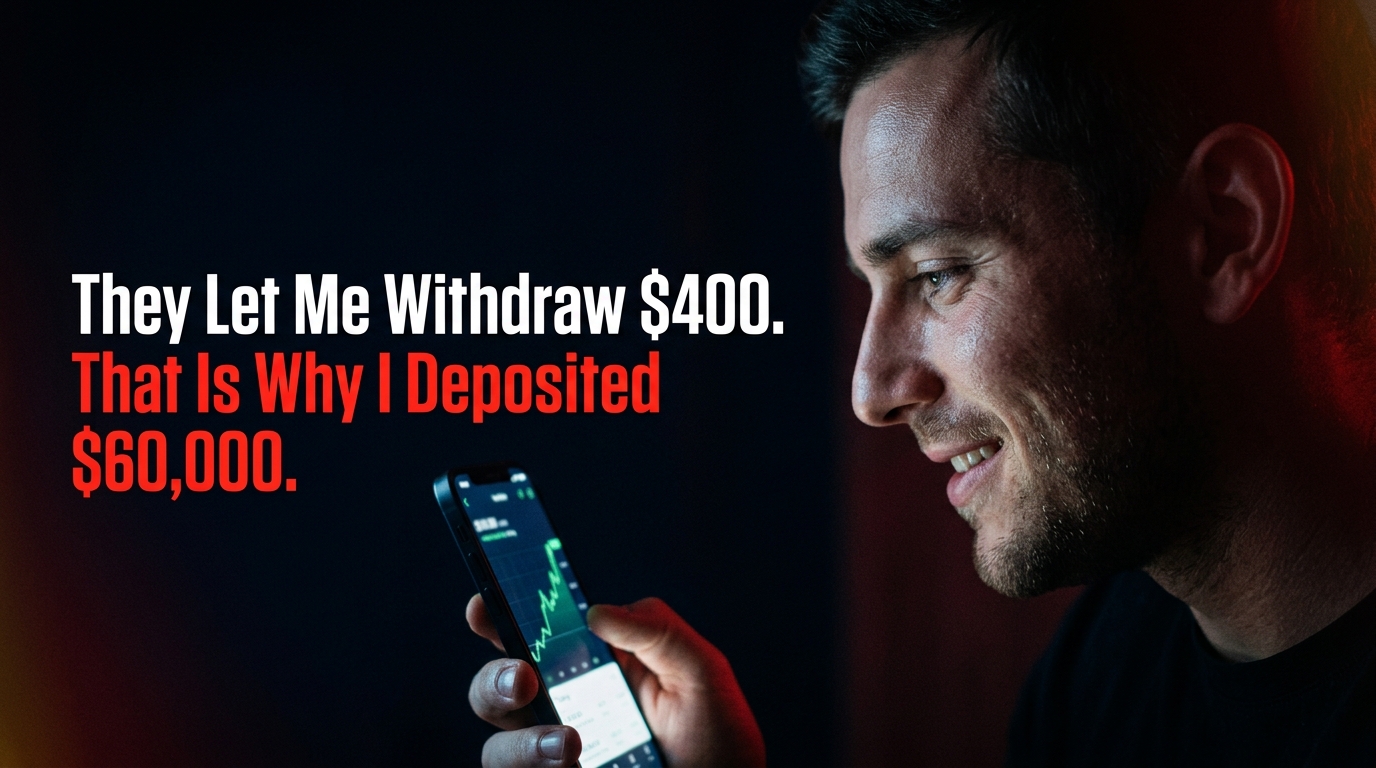
The most persuasive element of a fake trading app is not its design or its reviews. It is the small withdrawal it lets you make in the first week. That single transaction converts a sceptic into a customer more effectively than any amount of marketing, because it appears to answer the only question that matters. This tutorial explains why that withdrawal is manufactured, how the profit display works, and the nine checks that expose the platform regardless of how convincing the first test felt.
The engineering of trust: why the small withdrawal exists
A fabricated platform has one problem: a sceptical user wants proof before committing real money, and proof is expensive to fake in every direction except one. So they fake the cheapest proof there is — a small payout.
The operator releases a few hundred dollars, at a moment calculated to matter. That payment costs them almost nothing, and it buys the larger deposit that follows. Victims consistently describe this step as the moment they stopped worrying.
A small withdrawal proves the platform was not ready to burn your account yet. It does not prove the platform can return a large one, and it is not evidence of legitimacy.
The nine checks, in the order that catches the most
Run these before any deposit. Each check is external — none of them relies on trusting something the platform tells you about itself.
Notice that the withdrawal test is last but decisive. Everything before it is to protect you from needing it, and it is the only one that yields a conclusion rather than an indication.
| # | Check | How to run it | Fail signal |
|---|---|---|---|
| 1 | How you found it | Where did the link come from? | A DM, a group, a dating contact, a comment or a paid ad |
| 2 | Domain age | WHOIS on the exact domain | Registered within the last year |
| 3 | Publisher identity | Look up the app publisher, not the app | Shell company, mail-drop address, or unrelated portfolio apps |
| 4 | Regulator entry | Search the register directly, never their link | No entry, or a number belonging to another firm |
| 5 | Price feed | Compare their BTC/ETH quote to a public source | Diverges beyond a normal spread |
| 6 | Named team | Search each founder independently | Stock photos, or people with no presence outside the site |
| 7 | Withdrawal terms page | Read it before depositing | Any tax, unlock fee, release deposit or minimum balance rule |
| 8 | Support identity | Ask for the registration number in writing | Deflection, or a number that does not resolve |
| 9 | Minimum deposit, immediate withdrawal | Deposit the smallest allowed, then withdraw at once | Blocked, delayed, or a new requirement appears |
How the profit display actually works
The number you watch grow is generated locally. It is not connected to a market, which means the operator decides both the slope and the ceiling. This is why the fabricated balance climbs smoothly — real markets do not, and the smoothness is a tell rather than a reassurance.
The chart below shows the shape victims report, and the point at which the display stops being an inducement and becomes an excuse.
Fabricated profit display against money actually returned
Relative index — displayed balance by stage, and the share of victims who recovered any funds
Reading: The display is decoration with a purpose: it converts your own deposit into evidence that the platform is working, which is how the second and third deposits are justified.
The withdrawal refusal scripts, and the honest translation
Refusal ends the relationship. A conditional promise extends it, and the extension is where the additional deposits come from. These are the standard scripts.
| What they say | What it means | What to do |
|---|---|---|
| "Pay the withdrawal tax first" | There is no balance. The tax is the theft. | Stop. Report it. |
| "Minimum balance required to unlock" | A second deposit is the goal. | Stop. Do not top up. |
| "AML verification requires a deposit" | No legitimate platform requires a deposit in order to withdraw. | Stop. |
| "Blockchain congestion — try tomorrow" | Delay, while funds are moved past a recoverable point. | Request in writing once, keep the reply, then report. |
| "Account frozen for suspicious activity" | Shifting blame onto you so you comply. | Demand the policy in writing, then report. |
| "Pay network gas to our treasury" | Fabricated fee. Gas goes to the network. | Stop. Never send. |
The pattern in the marketing, not just the platform
Fabricated apps share a marketing playbook, and the marketing is often visible before the app is.
- 01A mentor or a group that is warm, available and slightly too interested in your financial situation.
- 02A "limited allocation" or a bonus that expires today. Urgency is what prevents the checks above.
- 03Testimonials with identical sentence structure and no surnames, often with the same stock photographs across sites.
- 04Payment only by crypto or bank transfer, with card payment "temporarily unavailable" — which removes the one route with a real dispute right.
- 05A bonus with a trading-volume condition, designed so it can never be unlocked, which locks your own deposit alongside it.
Never accept a bonus with a volume condition. The condition is not a reward mechanism; it is a lock on your own money.
If you have already funded it
Speed matters, and the most important action is the one you avoid taking.
- 01Do not pay any release fee, tax, verification deposit or gas top-up, at any amount, framed any way.
- 02Screenshot the full dashboard and transaction history immediately — access is usually cut once you press on withdrawal.
- 03Record every deposit transaction hash and receiving address. This is what makes every later filing usable.
- 04Contact your bank or card issuer the same day if any part came from a card or transfer.
- 05File at IC3.gov and ReportFraud.ftc.gov with the record attached.
- 06End contact with the platform and with whoever introduced it. The recovery agent who appears next is usually the same operation.
The visual summary
Everything above, reduced to the four stages that matter for this topic. If you only look at one thing on this page, look at this.

Where this fits in the pattern
Before contact
Nothing has happened yet. This is when every tutorial here is most useful and costs you nothing but reading.
During the approach
The script is running. The verification tests in this tutorial are designed to be run here, neutrally, without confrontation.
At the money request
The decisive moment. Any request for funds, fees, taxes or unlock deposits is the end of the script, not a stage of it.
After a loss
Prevention is over; evidence work begins. Preserve, report, and never pay a second fee to recover the first.
Common questions
Follow your deposit to where it landed
Enter the address the app gave you and the tracer produces the movement record you need for a card dispute, a freeze request or a police report.
Primary sources and further reading
- SEC — Investor Alerts and Bulletins www.sec.gov
- FTC — Investment Scams consumer.ftc.gov
External links open in a new tab so you can verify the underlying material yourself. TrueMoneyTalk is not affiliated with these organisations.
Prevention only works if it reaches people before the contact does.
Disclaimer: this tutorial is general information, not legal, financial or recovery advice, and is not a substitute for advice from a licensed professional in your jurisdiction. Individual outcomes vary and are never guaranteed.